This is the strategy that I have used for my high school physics class. I have used Hewitt’s Conceptual Physics textbook and its supplementary practice book in my class. At the beginning of the semester, I have my students take a pre-assessment quiz about basic mathematical skills and concepts in physics. Then, I have given at least 3 quizzes and 1 test per each unit to ensure students’ understanding. Moreover, I have lots of conversations in a class with the students. I make sure my students understand that I am here to help them out for this challenging class and it is everyone’s benefit if all of us can get through this together. I explain my teaching method and why I am trying to apply differentiated instruction to the class so that students can understand the necessities of it and do not misunderstand being in different groups as the sign of academic inferiority.
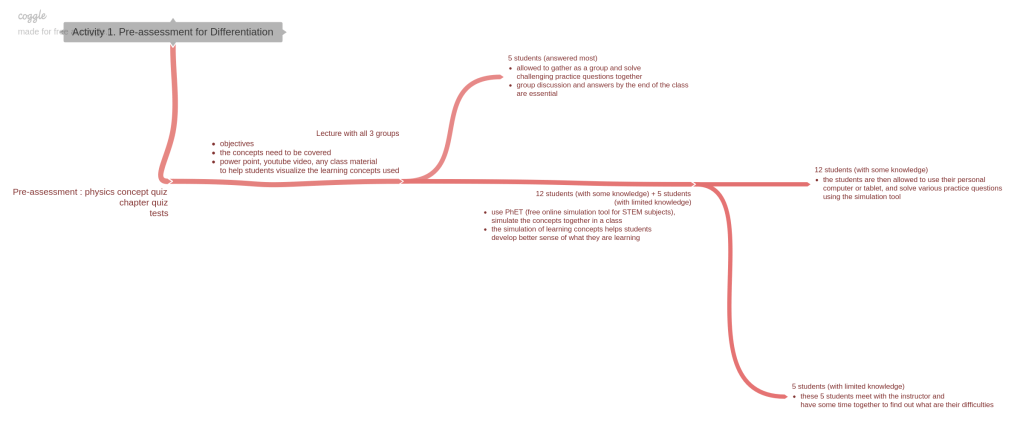
Based on the pre-assessment, quizzes, class observation, and tests, students are separated into three different groups. In the beginning of the class, the objectives of the day’s class is being explained and I give the students a lecture using a power point, youtube video clips, and other necessary class material in about 20 minutes. After that, students in the well-scored group are allowed to solve practice questions regarding the concepts that is being taught. Their job is to discuss about the challenging practice questions and get answers of them by the end of the class.
Then with the other two groups of students, we try to simulate the learning motions and concepts using PhET Interactive simulation tool. PhET is “a free science and math simulation for teaching STEM topics, including physics, chemistry, biology, and math, from University of Colorado Boulder.” This is a great tool to visualize challenging concepts in physics and chemistry. I lead the class, show them the simulation and try to involve the students into the process by asking them to come up with different input values for the simulation.
Students in the middle group are allowed to use their personal computer or tablets, simulate what I have shown in the class and solve the related questions. There are various types of practices ready for the students to try from the simulation program to an online practicing tool like quizlet.
While students in the other two groups are doing their tasks, students in the least-scored group meet with me. We seat together, and they tell me what and why they can’t understand the concepts. This is an essential part for helping students who are academically struggling. The instructor needs to get some time to listen to the students and try to understand how they think, and correct them if they are misunderstanding something from the base.
For the special needs students, the helps they need should be supported. For instance, I had a student with ADHD in my physics class. Though she was always in a well-scored group, she had a hard time seating on a chair and solving problem. We talked about it and decided to let her walk around in a class room as long as it does not bother the other students’ concern.
 seanecro's blog