유일한 내가 되어야 한다. 내가 아닌 다른 사람은 이미 누군가 차지했기 때문이다.
— Oscar Wilde.
내 새 블로그의 첫 번째 글입니다. 이 블로그를 계속 유지하면서 더 발전시키고자 합니다. 아래에서 구독을 신청하면 새 업데이트를 게시할 때 알림을 받을 수 있습니다.
유일한 내가 되어야 한다. 내가 아닌 다른 사람은 이미 누군가 차지했기 때문이다.
— Oscar Wilde.
내 새 블로그의 첫 번째 글입니다. 이 블로그를 계속 유지하면서 더 발전시키고자 합니다. 아래에서 구독을 신청하면 새 업데이트를 게시할 때 알림을 받을 수 있습니다.
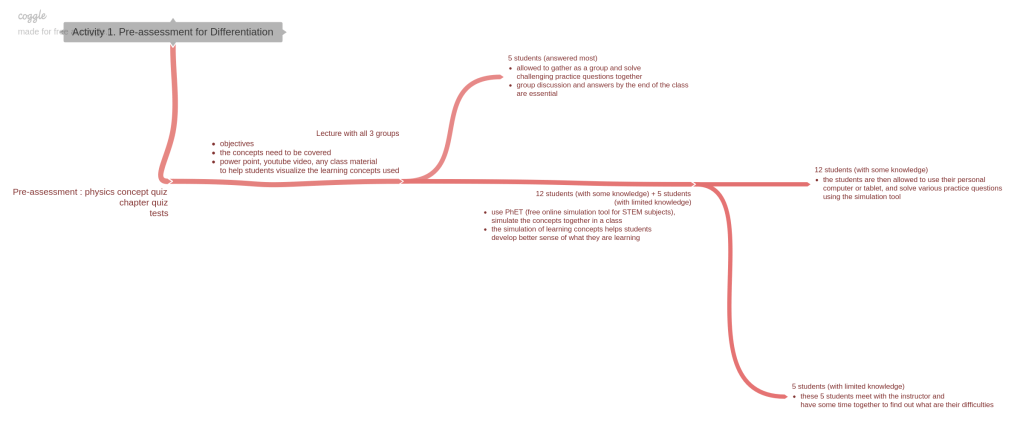
This is the strategy that I have used for my high school physics class. I have used Hewitt’s Conceptual Physics textbook and its supplementary practice book in my class. At the beginning of the semester, I have my students take a pre-assessment quiz about basic mathematical skills and concepts in physics. Then, I have given at least 3 quizzes and 1 test per each unit to ensure students’ understanding. Moreover, I have lots of conversations in a class with the students. I make sure my students understand that I am here to help them out for this challenging class and it is everyone’s benefit if all of us can get through this together. I explain my teaching method and why I am trying to apply differentiated instruction to the class so that students can understand the necessities of it and do not misunderstand being in different groups as the sign of academic inferiority.
Based on the pre-assessment, quizzes, class observation, and tests, students are separated into three different groups. In the beginning of the class, the objectives of the day’s class is being explained and I give the students a lecture using a power point, youtube video clips, and other necessary class material in about 20 minutes. After that, students in the well-scored group are allowed to solve practice questions regarding the concepts that is being taught. Their job is to discuss about the challenging practice questions and get answers of them by the end of the class.
Then with the other two groups of students, we try to simulate the learning motions and concepts using PhET Interactive simulation tool. PhET is “a free science and math simulation for teaching STEM topics, including physics, chemistry, biology, and math, from University of Colorado Boulder.” This is a great tool to visualize challenging concepts in physics and chemistry. I lead the class, show them the simulation and try to involve the students into the process by asking them to come up with different input values for the simulation.
Students in the middle group are allowed to use their personal computer or tablets, simulate what I have shown in the class and solve the related questions. There are various types of practices ready for the students to try from the simulation program to an online practicing tool like quizlet.
While students in the other two groups are doing their tasks, students in the least-scored group meet with me. We seat together, and they tell me what and why they can’t understand the concepts. This is an essential part for helping students who are academically struggling. The instructor needs to get some time to listen to the students and try to understand how they think, and correct them if they are misunderstanding something from the base.
For the special needs students, the helps they need should be supported. For instance, I had a student with ADHD in my physics class. Though she was always in a well-scored group, she had a hard time seating on a chair and solving problem. We talked about it and decided to let her walk around in a class room as long as it does not bother the other students’ concern.
Class : General Biology – Exploring Human Biology (Chapter 37 – 43)
Description : in this project, a class will be divided into 9 groups of 2~3 students each. There are 9 different topics for each group : Integument system, respiratory system, circulatory system, digestive system, excretory system, immune system, nervous system, endocrine system and reproductive system. Students of each group will be in charge of 10 to 15 minutes of class time as instructors, prepare and present their assigned topic to the class. You may use power points, printed lecture notes, posters, etc in your presentation. (If anything unusual is needed for the presentation, it needs to be discussed with me first)
Evaluation : your teaching presentation will be carefully evaluated based on a provided grading rubric. Every student in a class will actively participate in the evaluation and write a constructive feedback for speakers. Each speaker gets his/her own grade from this project and it is the sum of the average score from the students’ evaluation and teacher’s evaluation. (the outliers from the students evaluation will be removed from calculating the average score) Every student need to write a constructive feedback for each speaker and those who write best (well-observed and critically pointed) feedback will get extra credit for the project. Each student speaker will get all the feedback (including the instructor’s) at the end of the project, and write a self reflection about one’s own presentation.
Grading Rubric
이 글은 원래 Blogging University의 일부로 발행된 예제 글입니다. 열 가지 프로그램 중 하나에 등록하고 블로그를 올바르게 시작하세요.
회원님은 오늘 글을 공개하려고 합니다. 블로그가 어떻게 보이는지 걱정하지 마세요. 아직 이름을 정하지 않았거나 부담감이 느껴지더라도 걱정하지 마세요. “새 글” 버튼을 클릭하고 접속한 이유를 설명해 주세요.
왜 그렇게 해야 하나요?
글은 짧거나 길 수 있고, 자신의 삶이나 블로거로서의 사명을 소개할 수도 있으며, 미래에 대한 각오 또는 공개하고자 하는 내용에 대한 개요일 수도 있습니다.
다음은 시작하는 데 도움이 되는 몇 가지 질문입니다.
여기에 한정될 필요는 없습니다. 블로그의 멋진 점 중 하나는 계속해서 배우고 성장하고 서로 상호 작용할 수 있다는 것이니까요. 그러나 블로그를 시작한 곳과 이유를 아는 것이 좋으며, 목표를 구체적으로 정하면 또 다른 포스팅 아이디어를 얻을 수 있을 것입니다.
어떻게 시작할지 모르겠나요? 처음 머리에 떠오르는 것을 써보세요. 우리가 사랑하는 글쓰기에 관한 책을 쓴 Anne Lamott는 우리 스스로가 “형편없는 1차 초안”을 작성할 권한을 주어야 한다고 말했습니다. Anne이 아주 큰 지적을 했습니다. 우선 글을 쓰고 걱정은 나중에 하세요.
공개할 준비가 되면 글, 사진, 소설, 육아, 음식, 자동차, 영화, 스포츠 등 블로그의 초점을 설명하는 태그를 3~5개 정도 글에 붙입니다. 이 태그는 회원님의 주제에 관심을 가진 사람들이 회원님을 리더에서 찾을 수 있도록 도와줍니다. 태그 중 하나가 “zerotohero”인지 확인하세요. 그래야 다른 새 블로거가 회원님을 찾을 수 있습니다.

 seanecro's blog